Dissertation
The view I defend can be summarized by the following diagram:
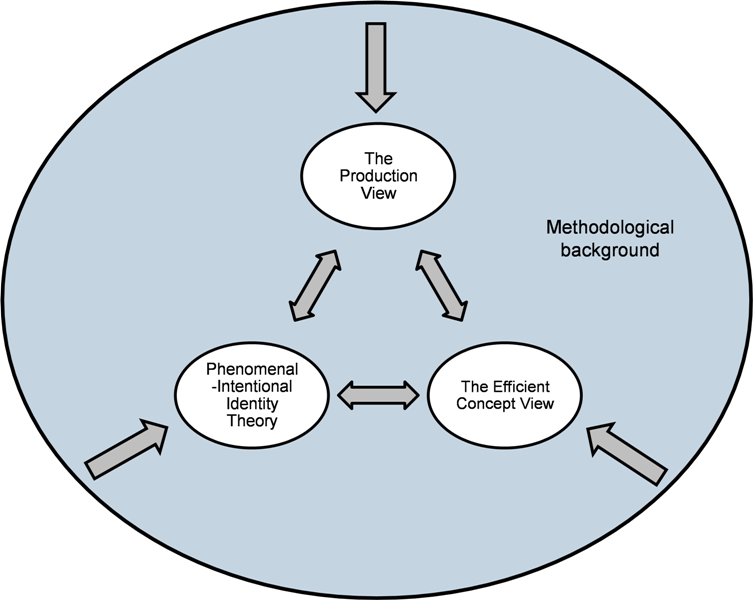
The Component Views
The general view is composed of three views that mutually support, and in some cases require, one another. They can each be independently motivated.
- The Production View
- This is a view about mental representation generally.
- Mental representation is a product of the mind or brain, as opposed to a relation between the mind or brain and something else (as on what I call a Relation View).
- Examples of Production Views are the mind-brain identity theory, at least some versions of short-arm versions of conceptual role semantics, the phenomenal intentionality theory, and adverbialism.
- Examples of Relation Views are certain direct realist views of perception and tracking or nomic dependence theories of mental representation.
- Arguments: My arguments for Production Views are mainly negative. There just do not exist the right things in the world for us to be related to in order for a Relation View to work. For instance, there are no color properties or instances such that we are plausibly appropriately related to them and they account for the representational content of our color-experiences. So, it is reasonable to conclude that our color-experiences are a production of our minds or brains. As a result of these arguments, we see that mental representation is not the same thing as tracking, since the things that we track are not the things that we represent.
- The Production View faces a challenge in accounting for the rich and varied contents that we seem to entertain, particularly in thought. We can think of possible worlds, complex social relations, and distant planets. The Relation View says that we get to represent these rich and complex contents by being appropriately related to rich and complex things (or combinations of things). The Production View, however, has to say that we somehow produce these contents, and it's a bit puzzling how this could be possible. This is where the Production View obtains some support from the Efficient Concept View, on which our concepts do not represent such complex contents (see below). We will also soon see that the Efficient Concept View is also more plausible on a Production View.
- The Phenomenal Intentional Identity Theory (PIIT)
- This is a view about the relationship between mental representation and consciousness.
- Mental representation and consiousness are type and token identical. They are one and the same thing.
- Arguments: Two familiar types of arguments for Intentionalism, the view that all phenomenal character is identical to some representational content, also support PIIT:
- Arguments from Transparency: When you look at the blueness of the background of this website, you do not experience represented blueness and a "raw" phenomenal feel of blueness. Attention to our experiences offers us evidence for only one blueness-related mental feature.
- An Impressive Correlation: In perception, differences in phenomenal character are accompanied by differences in representational content and vice versa. There is disagreement over whether this correlation holds in the case of (a) nonconscious states, (b) occurrent "conceptual" states, such as thoughts, and (d) non-occurrent "conceptual" states, such as standing beliefs. I propose that PIIT is sufficiently well-motivated in other cases so as to allow us to treat these cases as alleged counterexamples, rather than as cases primarily supporting the view. I claim that the Production View and Efficient Concept View offer PIIT the resources to deal with these alleged counterexamples.
- How to deal with the alleged counterexamples to PIIT:
- Nonconscious states: These states do not represent in the sense of "represent" that we are dealing with here. They might have something we can call "computational content", but if certain views I've argued for in arguing for the Production View are right, then there is no principled way to attribute to them representational content, and so I conclude that they do not have representational content.
- Occurrent "conceptual" states: These states do have phenomenal character, but it is fairly impoverished compared to the phenomenal character of perceptual states (and it may consist in images or representations of words). This is not enough to respond to the worry about occurrent thoughts, since PIIT requires an identity between content and phenomenal character, and it seems that thoughts' representational contents far outrun their phenomenal characters. However, if the Efficient Concept View is right, then thoughts have fairly impoverished representational contents as well, and PIIT's further claim that phenomenal character and representational content match up seems fairly plausible.
- Non-occurrent "conceptual" states: These states don't represent, although they can be activated to yield representational states. They have the same status as perceptual states not currently used in perception. Take the visual representation RED when you're not seeing anything red (or alternatively, the representations required to experience an entire visual scene when you're not experiences that scene). We don't say that you're representing redness just in virtue of having that state. I argue that we should think of non-occurrent "conceptual" states, such as standing beliefs, in exactly the same way. They can be recruited to form representational states, just like your representation RED, but we needn't say that they represent when not being used.
- And so, PIIT requires both the Production View and the Efficient Concept View. To the extent to which PIIT is independently motivated, we obtain some motivation for these views. To the extent to which the Production View and the Efficient Concept View are independently motivated, we obtain some support for PIIT.
- The Efficient Concept View
- This is a view about the structure and content of concepts.
- Concepts are structurally fairly simple and have fairly impoverished contents. Their contents do not correspond to what we intuitively take to be the contents of concepts. For instance, the concept MODAL REALISM does not repreesnt the view that possible worlds exist in the same way that the actual world exists, but rather something more impoverished, such as possible worlds view. Despite having fairly impoverished contents, concepts can be unpacked to yield further contents that we sometimes take to be further cashings out of the initially-entertained contents.
- For example, when we think that John is a modal realist, the concept MODAL REALIST might be unpacked into believer of the view that possible worlds exist in the same way that the actual world exists. When this happens, we experience this content as a further cashing out of what we were intitially thinking. The concepts involved in representing this new content, such as POSSIBLE WORLDS and EXISTENCE might likewise unpack into further contents that we take to be even further cashings out of what we were initially thinking.
- In this way, unpacking and experiences of cashing out conspire to create the illusion of richly contentful thought. I claim it makes sense to define new notions of derived content that capture some of these cashed out contents.
- There are various possible notions of derived content we can define. Different notions might be useful for different purposes. For instance, we can define a notion that captures the intuitive or folk psychological notion of content. It also turns out that what we intuitively take to be the conditions of truth and reference of thoughts and concepts are those of their derived contents, not their contents proper.
- Arguments: My arguments rely heavily on thinking about mental representation as psychologically involved, as playing a psychological role in thought and experience. From the roles they play, we can make inferences regarding their structure and content. I argue that concepts and contents behave in the way described above. They behave like they are simple and they unpack fairly reliably into contents that are much more complex.
- Concepts are central to many philosophical positions and arguments. This view of concepts is one on which concepts do bear interesting relations to what we intuitively take to be their contents, but nonetheless fail to really represent them in some psychologically real way. This feature of the position opens up new positions in old debates, such as debates concerning internalism and externalism about mental content, and debates over the richness of the contents of perceptual experiences.
- On the Efficient Concept View, our concepts and thoughts represent fairly impoverished contents. It is difficult to see how we can get appropriately related to such contents. Actual objects and property instances are too complex to play this role. Perhaps, then, we are related to vague or indeterminate properties. However, it is now hard to see how we can get related to those when all the property instances that we are related to are complex and determinate. Instead, the Efficient Concept View makes most sense on the Production View. On the Production View, our concepts and their contents need not neatly correspond to the things in the world that we are related to.
Methodological Assumptions
All this occurs in a background of certain methodological assumptions about how to do philosophy of mind.
- Mental representation is a phenomenon that we notice and can observe in ourselves. We have some kind of access to what we're thinking and seeing (although this access is probably fallible, especially if the Efficient Concept View is right). The fact that we have this kind of access straight away sets the problem of mental representation apart from certain other problems in philosophy where we have nothing but our intuitions to go on. Our theories must answer to our observations. This approach to the problem of mental representation motivates the arguments for PIIT, the arguments for the Efficient Concept View, and certain objections against Relation Views.
- This is a form of naturalism, although perhaps not naturalism as is sometimes conceived in the philosophy of mind. Sometimes naturalism is taken to be an ontological doctrine that is motivated by science. Then, a naturalistic theory of X is a theory that reduces X to entities on a list of scientifically-acceptable entities. However, this is not the type of naturalism that is best supported by what we like about science. Rather, the success of science supports a type of methodological naturalism. This is naturalism of the Noam Chomsky and Penelope Maddy variety. It's a sober way of approaching a topic of study, one that takes seriously the evidence and flows with it, rather than against it, and privileges explaining the phenomena over achieving desirable metaphysical results.
These methodological assumptions can be independently motivated, but perhaps the best motivation would be the plausibility and fruitfulness of the resulting view.