
Iisakki Kosonen
Helsinki University of Technology,
Transportation Engineering, P.O.Box 2100, FIN-02015 HUT, Finland
Iisakki.Kosonen@Hut.Fi
Andrzej Bargiela
The Nottingham Trent University,
Real-time Telemetry Systems, Butron Street, Nottingham, NG1 4BU,United
Kingdom
andre@doc.ntu.ac.uk
| Contents
1. Introduction 2. Real-time simulation 3. Using the real-time data 4. Technical framework 4.1 Simulation of Mansfield test area 4.2 Developing Internet and GIS interface 5. Conclusion References |
ABSTRACT
The paper summarizes experiences in the development of a real-time
simulator which underlies the implementation of novel traffic information
systems. The research project was carried out in collaboration between
the Helsinki University of Technology (HUT)/ Laboratory of Transportation
Engineering and the Nottingham Trent University (NTU)/ Department of Computing
during a one year period from September 1997. The HUTSIM microscopic simulation
model was interfaced to the SCOOT-urban traffic control system providing
real-time traffic data through the Distributed Shared Memory system (DIME)
developed at NTU. The emphasis of this paper is on presenting the principles
of interfacing micro-simulation model to real-time field measurements,
demonstrating a prototype implementation and outlining the range of information
services that can be provided on the basis of such a system.
KEYWORDS:Real-time simulation, distributed processing, information services. |
2.
Real-time simulation
The main idea behind the real-time simulation is that of the use of
real-time traffic measurements as input data to microscopic simulations.
In such a context, various non-measured traffic parameters, that can be
deduced from micro-simulations, are deemed to be a good approximation of
the reality by virtue of being based on the actual measurements. Although
the prototype system presented in this paper makes use of the specific
microsimulator (HUTSIM) and the urban traffic control system (SCOOT), the
approach is general and is applicable to any traffic control system that
supplies the required real-time data.
The basic data obtained
through the traffic telemetry systems is the lane-occupancy data from detectors
embedded in the road surface. Each detector provides information about
the presence or absence of a vehicle in a discrete location. The rest of
the information about traffic situation must be derived from the general
knowledge of system layout, statistics of the traffic patterns and the
estimate of vehicles= dynamics.
In a simulation model all these factors are methodically combined. The
simulation model provides also an engine for creating hypothetical traffic
situations and for deriving higher order measures to be used by traffic
information services.
In the absence of the actual
traffic data from the detectors, simulation model generates vehicles on
a statistical basis. Ideally this should be accurate enough to produce
reliable average measures i.e. in off-line simulation mode. However, in
real-time operation average measures are not always relevant, so the micro-simulation
model is made realistic by replacing the time headway distribution with
real-time arrivals. Since the simulation model is to mirror the operation
of the actual traffic control system it requires also the real-time signal
status data.
The real-time simulation
approach postulated here extends significantly the monitoring capabilities
of telemetry systems by extrapolating the traffic occurences in discrete
locations through to the simulation of realistic traffic flows in the whole
of the network.
3.
Using the real-time data
The accuracy of real-time simulations clearly depends on the accuracy
and the availability of the relevant detector data. Within the limits of
the accuracy of the traffic model, the presence of discrepancies between
the real and the simulated traffic can be seen as an indication of the
potential for the improvement of the telemetry system itself. If the measurement
data is inaccurate or incomplete the simulation will highlight this fact
by demonstrating the cumulative effect of these errors.
In a real-time microscopic
simulation model, individual vehicles are generated according to the lane-occupancy
detector data. Vehicle arrivals are recognized from the edges of detector
signal i.e. the changes of signal status from passive to active or vice
versa. Usually a single vehicle corresponds to the occurrence of one pair
of edges (pulse). However, some detectors cover two lanes and therefore
it is possible that two vehicles travelling side-by-side produce only one
pulse. This introduces an error into real-time simulations which may be
significant when traffic volume is high. Another source of discrepancies
between the simulations and the reality is the absence of information about
parking and minor streets traffic and the inaccuracy of the estimates of
the turning movement percentages.
Consequently the lane-occupancy
data has to be augmented by some additional measurements that facilitate
resetting of the cumulative errors in simulations. In the SCOOT environment
such a resetting of errors can be facilitated with special queue length
detectors. When these detectors indicate continuous occupancy over several
seconds this is considered to be an indication of a queue extending from
the stop-line up to the detector. The SCOOT-model employs this type of
detectors in resetting its own queues so that the >back-of-queue=
data reported in the SCOOT messages is a dynamically validated indirect
measurement that can be used by the real-time simulator.
Accepting that the simulated
traffic will always differ somewhat from reality, because even comparatively
small errors can accumulate over long periods of simulation, it is important
that a real-time simulator employs some mechanism for resetting the errors.
In the HUTSIM model this is facilitated by corrective generation and/or
removal of vehicles in the links. This type of procedure has been shown
to be effective in correcting discrepancies, on a continuous basis, thus
preventing the build-up of errors.
Within the context of real-time
simulations, detector data can be used not only to generate the instances
of vehicles in specific locations but also to improve the accuracy of the
model of driver dynamics, the estimates of turning movement percentages,
the estimates of discharge flow rates etc. For instance if lane-occupancy
detectors are deployed at each exit from an intersection, turning movements
can be calculated on the moving average basis and be compared with the
values used by the simulator. If the corresponding queues in the "downstream"
links indicate a systematic error that is positive for some links and negative
for others, then the turning movement coefficients are adjusted in the
model. On the other hand, if the errors are all positive or negative in
the "downstream" links, then the discharge flow rates can be adjusted accordingly.
When detector data is available
immediately after the stop line, this data could be used for on-line adjustment
of the discharge flow rate. This also allows dynamic adaptation of discharge
flows which may vary during the day. Furthermore, if separate detector
data is available for multiple lanes, this data could be used for tuning
the lane change parameters. Also, when lanes determine the direction of
turning it is possible to adapt turning movements on the basis of the incoming
link data.
It should be pointed out
that while HUTSIM normally operates on OD-matrix basis, it can be set to
deal with turning percentages by adding route generators to each internal
link. A route generator will randomise a new turning direction for every
passing vehicle.
4.
Technical framework
A prototype of the real-time simulation system has been constructed
using the distributed shared memory environment (DIME) developed at NTU.
This enables several pieces of software to execute on networked computers
while cooperating in performing the simulation task (Figure
1).
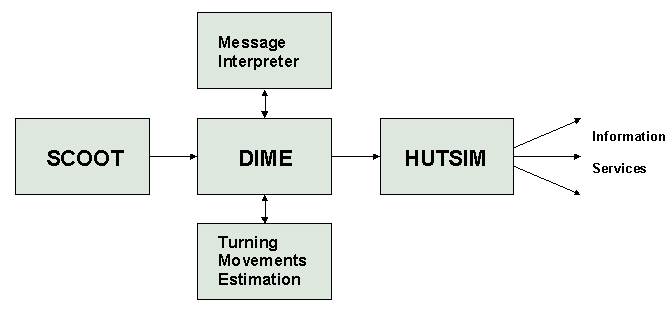
Figure 1
The implementation of HUTSIM / DIME real-time simulation
Each process connects to
the shared memory manager which runs in either UNIX or Windows-PC environment.
The memory manager acts as a server to which multiple clients can connect.
Each client can have a read and/or write access to several areas (buffers)
of the memory manager. A client can also create a memory area with an exclusive
write access so that other clients, that connect to that area, are allowed
a read access only. Two types of areas are supported in DIME namely buffers
for passing messages and arrays for sharing static data.
One of the clients connected
to the memory manager is the SCOOT-system which provides real-time telemetry
data. The real-time simulation application makes use of two types of messages
from the SCOOT system: M19 and M14. The M19-messages supply the detector
status data. These messages are generated once per second for each detector
and they contain the last four states of the lane-occupancy detector with
0.25 second resolution. The M14 messages are generated every four seconds
and supply the link flow and the queue length data together with the signal
head status over the last four seconds. Although only the >vehicle
occurence= and the signal head
status are mandatory for the simulations, the queue length data from the
M14-message is also used for resetting of the cumulative error.
The M19 and M14 buffers
of the DIME memory manager are read by the message interpreter client which
converts them into a suitable format. The interpreter turns the SCOOT detector
data (M19) into HUTSIM vehicle arrival messages by identifying changes
in the detector status. Changes in the signal heads status are identified
in the M14 data and are converted into HUTSIM signal change messages. Because
only the changes of the status are recorded the amount of output data is
much less than the amount of input data. The output messages are written
into another DIME buffer readable by other clients like HUTSIM. The message
interpreter successfully isolates the simulation task from the SCOOT specific
interface issues.
The turning movement estimation
client was originally developed for the predictive macroscopic simulation
model (PADSIM) but it could also be used here in the context of micro-simulations
to provide adaptively updated turning movement coefficients. The estimation
results are stored in a static memory array of DIME since the coefficients
are updated only every 20 minutes. The message interpreter reads the array
and generates HUTSIM-messages that update the turning percentages of traffic
generators of boundary links and route generators of internal links. These
messages are stored in the same DIME buffer as the vehicle arrival and
signal messages. In the current version however, the turning movement coefficients
are kept constant throughout the simulation.
Finally the fourth client
of the system is the simulation program itself. HUTSIM is operating normally
and is running with real-time speed processing external events provided
by an input stream. The input stream can be supplied from various sources,
but most commonly from an input file. In the case of real-time simulation
the input stream is supplied by the message interpreter through the DIME.
The present implementation involves three types of messages namely the
vehicle arrival-, signal change- and turning percentage messages.
The whole communication
link is quite long. From the Mansfield test area to the Nottingham Traffic
Control Centre and from there to the memory manager run at the Nottingham
Trent University. Finally, after being processed by the message interpreter,
the messages reach HUTSIM. Since both the local- and the wide area network
are subject to random fluctuations of the communications load, the maximum
delay of the whole chain can be several seconds and messages can appear
in bursts. Therefore, in the interest of realism the message processing
has been based on time stamping. By offsetting the simulation, by a time
representing the maximum communications delay, the random delays in communications
are prevented from affecting the simulation. In the test system, a 15 seconds
offset has been found sufficient under most circumstances.
4.1
Simulation of Mansfield test area
The HUTSIM / DIME real-time simulation system described here
has been implemented at the Nottingham Trent University and is connected
to the SCOOT-system of the Nottingham Traffic Control Centre. The system
typically runs as a fully distributed application with each of the four
cooperating tasks executing on a separate computer. However the DIME framework
does not place any constraints on the hardware configuration and e.g. HUTSIM
and the message interpreter can run on the same PC while the memory manager
and the turning movements estimator can execute either on a UNIX workstation
or a PC. The HUTSIM / DIME simulation is running successfully and the framework
has shown itself to be reliable.
The performance of the system
has been validated through real-time simulations of the Mansfield-south
SCOOT area. This test area covers six intersections in the of Mansfield.
The rush hour traffic in this area is very busy. A detailed HUTSIM-model
was constructed (Figure 2) including the geometry, lane
organisation, detector positions etc. The boundary link detectors were
replaced with vehicle generators and internal links were equipped with
route generators. All signals and generators were labeled according to
the link and detector numbers of SCOOT so that that all messages could
be delivered to the correct object.
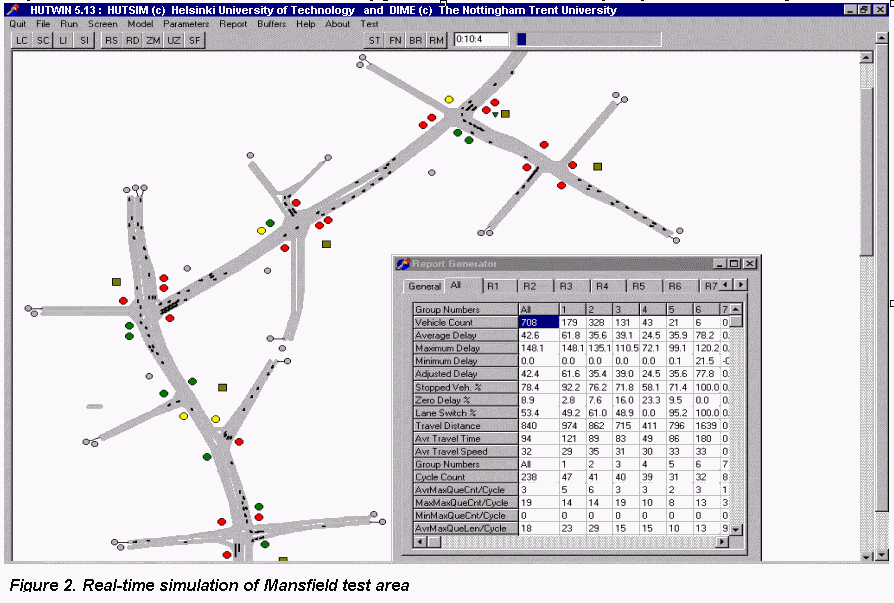
Figure 2 Real time
simulation Mansfield test area
In order
to compare the simulated and the real traffic, a "bird's eye" video recording
of the entire SCOOT area would be most useful. However, such an recording
was beyond the means of this project. An alternative video recording of
individual approaches to all simulated intersections was also considered
uneconomical and exceedingly tedious when attempting to time-synchronise
24 video recordings and the teal-time simulations.
As a practical approach
we have used therefore the queue measure from the M14-SCOOT message and
have compared it with the queue simulated by HUTSIM. The SCOOT queue is
expressed in LPU:s (Link Profile Units) and has been found to provide a
good estimate of vehicle count. The results of the field validation of
the SCOOT queue as a measure of the number of vehicles on the stop-line
has been performed for a number of intersections and a representative set
of results is given in Figure 3. It can be seen that
the majority of queue readings give an unambiguous vehicle count and the
statistical variability of readings is a realistic reflection of the variability
of vehicle types.
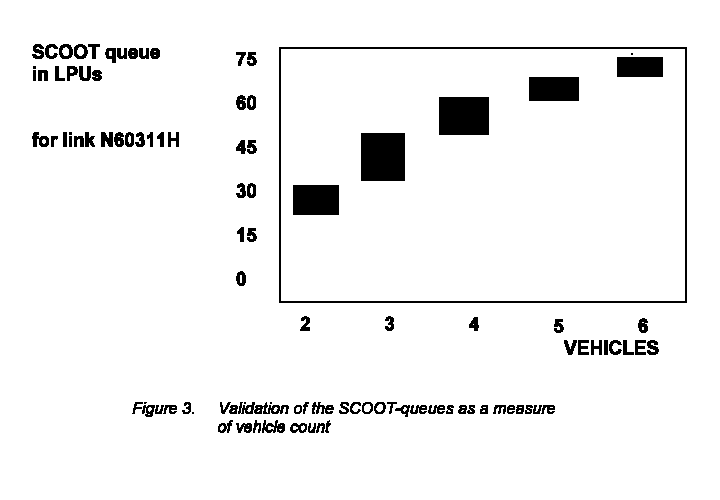
Figure
3 Validation
of the SCOOT-queues as a measure of vehicle count.
Preliminary
simulations show that the matching of vehicle counts on boundary links
was good. In internal links the matching between simulation and field data
can be improved by tuning the model parameters. Especially the discharge
flow parameters may need to be adjusted properly for each link. The results
show that there is also a need for refinement of the calculation of dynamic
turning movement coefficients which are adversly affected by the missing
data in some of the links. Consequently, static turning movement percentages
need to be used in some cases.
Because the number of settings
and parameters can be quite large, the manual tuning of the simulator can
easily becomes tedious. The preliminary experiences indicate that there
is a need for adaptive tuning of the parameters. This is one of the areas
to be addressed in future research.
The computational performance
of the simulation system executing on a 200MHz Pentium PC has been found
to be sufficient for this size of model. For larger models the performance
issues may need to be reconsidered. The critical factors are the size of
the simulation model and the maximum rate of data communication.
4.2
Developing Internet and GIS interface
The HUTSIM / DIME real-time simulation system can already be used by
several parties who already have the simulation program itself and have
access to the Internet connection. However, it is believed that many more
users and general public could benefit from the results of real-time simulations
of urban traffic if these are made available in an accessible form on the
World Wide Web (WWW).
Building on the HUTSIM /
DIME system the research has been extended to develop techniques facilitating
the use and diffusion of traffic data within a geographical context. We
intend to provide, at the interface level, an open and flexible system
for managing the integration, manipulation and display of geographic information
for the benefit of traffic management applications. The system will allow
to display and query geographical and traffic data in an integrated graphical
interface. Traffic data will be overlaid on urban maps for location reference.
These multiple data views allow the user to examine different aspect of
data. The identification of potential users and respective technical skill
and needs is an important objective of our interface development (McGraw
1992). Modularity allows a progressive application and to accept different
user-interaction levels from engineers to decision-makers. In particular,
our system is seen as contributing to a broader issue of investigating
new solutions for the diffusion of traffic simulation results.
From a database point of
view, the traffic system domain exhibits both static and dynamic characteristics.
Static components are data objects such as street layouts and topological
features such as roads. These features are considered as static within
a traffic system that examines short time scales in object transformations.
Dynamic components (measured or simulated) are objects that change on a
relatively short time scale from an application point of view (e.g. cars,
traffic queues, traffic signals). Our objective is to identify significant
properties about the dynamic traffic mechanisms, to explicitly record relationships
among entities involved in traffic processes, and to model causal relationships
when they are identified from an application point of view. We consider
different abstraction levels in both space and time in order to integrate
different levels of spatial and temporal details. At each abstraction level,
computing models generate a set of database primitives from measured and
simulated measurements (Figure 4).
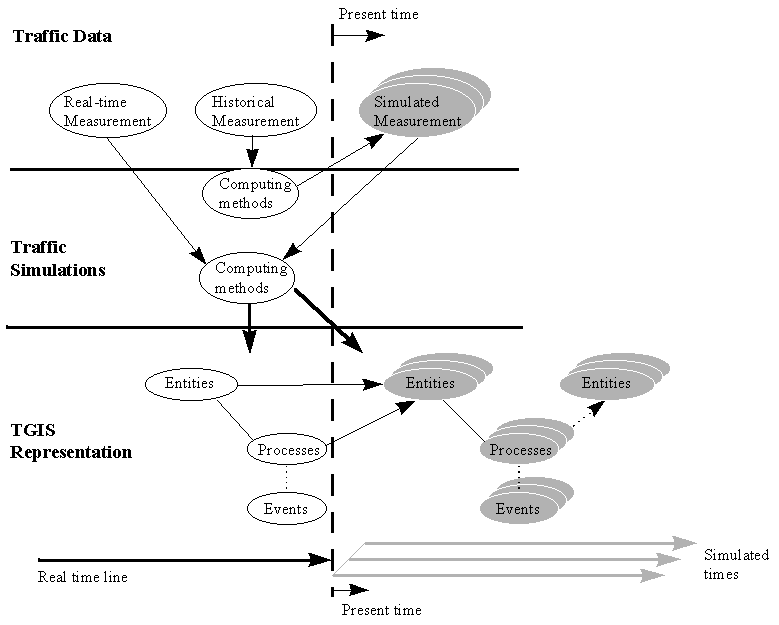
Figure
4 Temporal geographic information system (TGIS) - traffic model
principles.
The proposed interface integrates
geographical data and traffic data and supports adaptive transmission depending
on the final user requirements and capabilities. The database integrates
the static and dynamic components of a traffic system including the network
infrastructure, real-time traffic data (e.g. queues, traffic flow), geographical
data, descriptive and statistical data. The geographical component of the
interface is used as a context background that complements the visual environment
of the graphic interface.
The simulation results can
also be made accessible directly through the Internet as discussed by (Gul,
1998). Graphic and numerical data provided by HUTSIM and SCOOT can
be made visible for ordinary web users. In Figure 5 alternative
methods are outlined.
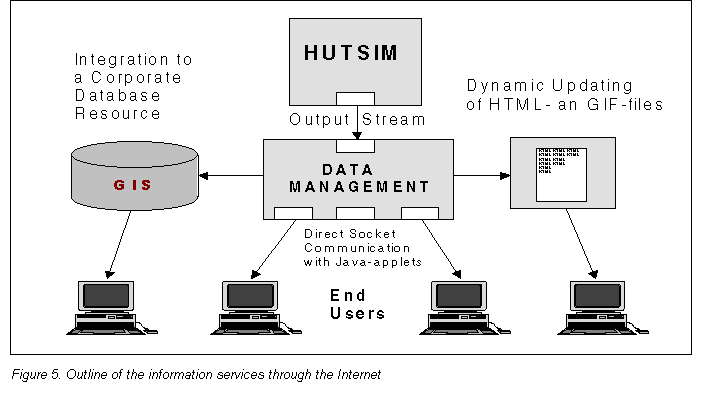
Figure 5
Accessibility
of the simulation results via the Internet
The most straight forward
method is to update HTML-files on the web-server. The simulation could
produce an HTML-file as an output, which is then transferred to the server
for replacement of the existing file. Initially a BMP file is generated
by the HUTSIM application every minute this is a screenshot of the simulation
depicting the current traffic situation. Once the BMP image is captured
it is converted into a GIF image which then dynamically updates an HTML
file at a given time interval. This allows users with net connections to
view the traffic simulation in a static form.
Further output tables can
be generated by the HUTSIM application to display the delay, traffic queue,
and travel times statistics as shown in Figure 2.
An output file containing this report data can also be generated to be
used in web pages.
More advanced solutions
can be obtained by utilising the HUTSIM output stream (Table
1). The output stream can be directed to a socket interface that allows
other clients only to read the data in real-time.
| Time | Time |
| RT 01 | RT 02 |
| Object_ID | Light_ID |
| X1 | X1 |
| Y1 | Y1 |
| X2 | Light Status |
| Y2 | |
| CR/LF | CR/LF |
The Java application can
work by opening a client socket to receive the data output stream from
the HUTSIM application. The socket can use TCP/IP-protocols to establish
the link between the two applications. A Java application can be programmed
to receive the vehicle coordinate data as shown in Table
1, and to show on-line animation of the simulated traffic.
A carriage return (CR)/
line feed (LF) command follows each string this determines the next set
of data to read. This string is received for each vehicle on the system
and traffic light on the simulation. As this is received the data is tokenised,
so that the sets of data can be grouped for plotting the cars and lights,
within the memory buffer.
With the coordinates being
received into memory, these can then be plotted onto the screen ensuring
the vehicle coordinates and the screen image of the Mansfield area coincide,
so that when the cars are drawn on the screen they are actually on the
roads and not on the verge. This animation would run in a web-browser showing
the overview of traffic situation to the user.
The application is compliant
with different user-needs. For instance, very fast Internet connections
may use on-line animation while slow connections may display a relevant
graphic state of the traffic system using appropriate time scales that
depend on the local system configuration and on the application objectives.
Different Java application levels offer different views depending on the
user needs and computing configurations (e.g. terminal types, screen sizes).
Users of such a system would
be all organizations involved with traffic system operation such as emergency
services, network maintenance, planning and environmental research. Such
an application provides an adaptive environment that opens new perspectives
to the use of traffic simulation systems in the new emerging information
society.
Conclusion
The HUTSIM / DIME system has been implemented and is running successfully
on a network of distributed computing nodes. The system demonstrates the
principle of real-time simulation and it=s
benefits. Further research is needed to study in depth the achievable accuracy
of real-time simulations. This will involve full scale comparison of field
data with simulated measures. The research is also likely to result in
improvements in the telemetry system by suggesting the optimal number,
type and location of detectors in support of real-time simulations. The
motivation for further research is twofold: to provide a reference data
for the various information services and to develop a reliable predictive
model of urban traffic in support of future traffic control strategies.
Increasingly, the combination
of simulations and the real traffic data are providing essential information
for management and decision making. In this context the capability to communicate
information in an intuitive way through a geographic information system
can lead to involving general public in aspects of urban traffic planing
that touches upon their daily lives. Traffic information systems can be
used for the analysis of a wide range of practical environmental issues
such as noise and air pollution management. Integration of traffic simulation
information within graphical systems will provide crucial information to
environmental monitoring and planning applications. An increase in the
use of such systems in the context of urban traffic management is likely
to enhance the sustainability of cities, which has been identified as a
priority research task.
References
Abel D. J., Yap. R., Ackland R., Cameron, M.A., Smith, D. F. and
Walker G. (1992) Environmental Decision Support System Project: An
Exploration of Alternative Architectures for GIS, International Journal
of GIS, 6(3); 193-204.
Argile A., Peytchev E., Bargiela A., and Kosonen I. (1996) DIME: A shared memory environment for distributed simulation, monitoring and control of urban areas, Proc. ESS'96, Genoa, 1996, Vol.1, pp.152-156.
Etches A., Claramunt C., Bargiela A., and Kosonen I. (1998) An Integrated Temporal GIS Model for Traffic Systems. Geographic Information Systems Research in UK (GISRUK). April 1998, Edinburgh, UK.
Goodchild M. F. (1998) The Geolibrary, In: Innovations in GIS 5, S. Carver (ed.), London: Taylor and Francis, pp. 59-68.
Gul I. (1998) A Java Interface for Traffic Simulation, MSc Industrial Computing Systems Dissertation, The Nottingham Trent University.
Kosonen I. (1996) HUTSIM - A Simulation Tool for Traffic Signal Control Planning. Helsinki University of Technology, Laboratory of Transportation engineering. Licentiate Thesis. pp. 150.
McGraw K. L. (1992) Designing and evaluating user interfaces for knowledge-based systems. Chichester: Ellis Horward.
Moss et al. (1998) The KINDS project: providing effective tools for spatial data accessibility and usability over WWW, In: Innovations in GIS 5, S. Carver (ed.), London: Taylor and Francis, pp. 69-77.
Peytchev E., Bargiela A. and Gessing R. (1996) A predictive macroscopic
city traffic simulation model, Proc. ESS'96, Genoa, 1996, Vol.2, pp.38-42.
 JGIDA
vol. 3, no. 1
JGIDA
vol. 3, no. 1
 JGIDA
Home
JGIDA
Home


