
Journal
of Geographic Information and Decision Analysis, vol.3, no.1, pp. 56-63,
1999
A Software Environment
to Integrate Urban Traffic Simulation Tasks
Rosaldo José Fernandes
Rossetti
Instituto de Informática
- PPGC, Universidade Federal do Rio Grande do Sul, Caixa Postal 15064,
91501-970 Porto Alegre - RS, Brazil
rossetti@inf.ufrgs.br
Sergio Bampi
Instituto de Informática
- PPGC, Universidade Federal do Rio Grande do Sul, Caixa Postal 15064,
91501-970 Porto Alegre - RS, Brazil
bampi@inf.ufrgs.br
Contents
1.
Introduction
2.
An integrated data model
3.
The CATIA software environment
4.
Interfacing with external tools: an example
5. Conclusions
References |
ABSTRACT
This paper describes the CATIA software environment, which is oriented
to the integration of CAD tools. The main functionality provided by CATIA
is the ability to support the traffic engineer throughout several phases
and to integrate the tools that are demanded to analyze urban traffic systems.
An open architecture combined with an object-oriented data model of the
application domain provides for advantageous features when compared to
classical tools and engineering environment for CATE (Computer Aided Traffic
Engineering). The modeling, the implementation and results obtained are
described, emphasizing the architecture of the inter-tool communication
facilities.
KEYWORDS:
computer aided engineering,
interactive simulation, object-oriented simulation, traffic engineering. |
1.
Introduction
The evolution of complex urban agglomerates has posed significant challenges
to the city planners in terms of optimizing traffic flows in a normally
congested traffic network. Such planning and optimization relies on advanced
CAE/CAD tools to model, simulate, design and operate complex urban traffic
systems. Simulation and analysis of such systems require modeling the behavioral,
structural and physical characteristics of the road system, which include
at least the mobile agents themselves and the roads and intersections.
A large number of variables
are used to characterize the flux of traffic, and its behavior can be forecast
and optimized by very complex simulations, which require sophisticated
software tools. The urban planner has to rely on a large number of tools,
each one dealing with specific models and related variables of the systems.
Among the several types of analysis to be dealt with in the traffic simulation,
one can point the study of individual intersections, the evaluation of
traffic management and allocation schemes, performance evaluation of road
sections, and the study of traffic area control schemes. Tools such as
CONTRAM (Taylor 1990), SATURN (Watling
1991; Van Vliet 1992), SIDRA (Akçelik
1991), TRAF-NETSIM (Paksarsawan et al.
1992), TRANSYT (Willumsen 1989a; Willumsen 1989b;
Willumsen 1989c) are traditional in the trade. TRANSYT, for instance,
is applicable to traffic control area modeling, SIDRA models and simulates
individual intersections to optimize local intersection flows through lights,
and SATURN models global traffic allocation throughout the network using
coarse models of origin and destination demanded by urban commuters.
An important evolution,
required for the sake of productivity by the urban planner, is the integration
of tools, models and analysis methods, which have been developed for individual
domains, into a common simulation framework. Such framework has to support
inter-tool communication and a common visual interface to drive the modeling,
simulation and result analysis phases. There are environments proposed
in the literature, such as ASTERIX (Barcelo 1991),
targeted to address in part some of these requirements, and tools which
target the human-machine interface improvement for a given application
for traffic simulation, as in the case of INGRATA (Briceño
et al. 1995).
In this paper the specification
and implementation of the software environment CATIA are presented. This
system is dedicated to Computer-Aided Traffic Engineering (CATE). The main
functionality provided by CATIA is the ability to support the traffic engineer
throughout several phases and tools that are demanded to analyze urban
traffic systems. CATIA has been implemented under a PC Windows 95 O.S.
in DELPHI object-oriented programming language (Rossetti
1998). A common user interface, a unique data model that is integrated
into a general object model frame for a broad range of objects dealing
with the urban plant, as well as powerful inter-tool communication facility
intended to support several simulators, are a few of the distinct characteristics
of the software environment implemented at UFRGS University. A proof of
the concept of open interface to commercial black-box simulators was implemented
using SATURN, a commercial tool of wide acceptance that has been used to
model traffic assignment. The CATIA environment model supports both microscopic
as well as macroscopic traffic simulation tools, and the black-box interaction
is important to preserve the investment on widely used legacy systems that
were built with traditional software engineering and Fortran programming
languages.
Challenges and optimization
goals that are recurring in current practice of urban traffic planning
and operation, as well traditional simulation techniques are briefly described.
Following suit, the data models for the CATIA environment, its basic structure
and finally examples of integrated use with third party tools are presented
in this paper.
In traffic systems analysis
and planning one has to deal with models of the entire city, which include
population density, road network, land usage, land development, demand
profile from traffic sources to sinks, intersection controls, encompassing
a large set of geo-referenced data. The vehicle flow monitoring and data
gathering are facilities very seldom integrated into such simulator systems,
which demand control system facilities that are not addressed in this paper.
Integrating information from city plan data to traffic flow today is a
real challenge, since the traffic engineer has been dealing with separate
tools to address each specific analysis task; non integrated tools, inconsistent
data models, and widely different computer interface environments add more
difficulties to the final task of the simulation engineer. An integration
of several modeling domains is a starting point for the development of
an integrated environment such as CATIA.
2.
An integrated data model
Accurate data modeling is required to describe in a clear and organized
way the entities of an urban traffic system. In CATIA an object-oriented
modeling technique is used, such that its implementation approach provides
an organized and hierarchical structure in different levels of abstraction
to describe the system entities. Such a structure facilitates the system
viewing in many detailed levels from a macroscopic to a microscopic model,
as the movement is dealt with consistently both in a global as well as
in an isolated way. OMT was chosen as the object-oriented technique (Rumbaugh
et al. 1991). The basic class diagram is incrementally detailed in
Figure 1 and Figure 2.
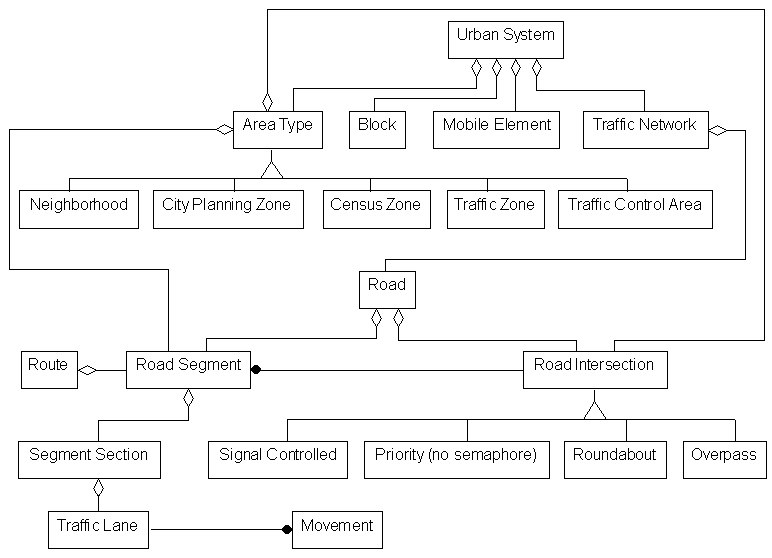 Figure 1
The basic class diagram
Figure 1
The basic class diagram
|
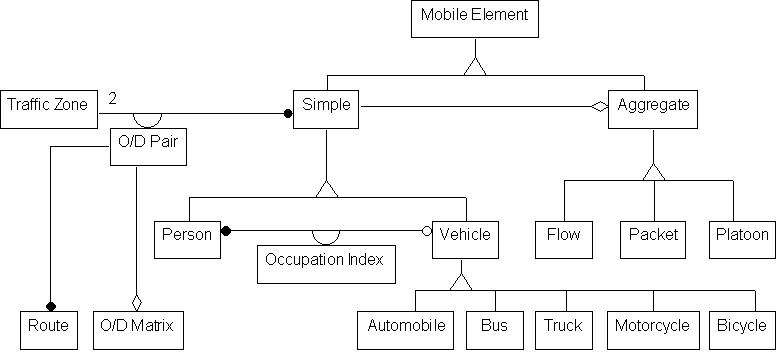 Figure 2 Basic
class diagram - the mobile element hierarchy.
Figure 2 Basic
class diagram - the mobile element hierarchy.
|
An intuitive as well
as formal description of the system entities and the relation among them
are provided by the object-oriented model features such as aggregation
and inheritance of the objects of Figure 1 and
Figure 2. The models are common to all software tools
driven by or integrated to CATIA, so that this facilitates data exchange
and intercommunication among analysis tools applicable to very different
views of the traffic system.
3.
The CATIA software environment
CATE (Computer Aided Traffic Engineering) tools aim to provide the
user an appropriate software environment to aid the various design and
analysis tasks in traffic engineering. The CATIA environment constitutes
an integrated tool set to aid the engineer specifically in the urban traffic
application domain. The CATIA specification is based on three main features:
Object oriented data model. Such a hierarchical and intuitive
model is the basis of the environment, as described in section 2.
Integrated Software Environment. Provides the integration of
different analysis tools aiming to address the various problems into the
application domain. The goal is to render usable within the environment
many traditional tools already in heavy use. Moreover, CATIA offers the
user a more interactive environment to use already-available tools, adding
value by the fact that many traffic simulators, despite of having great
technical qualities, are poor in terms of graphics user interface. Used
in this mode, the CATIA environment is not adding an analysis model, but
in fact providing a support environment. An integrated environment facilitates
the addition and the productive usage of new analysis tools, as the interface
and the models are reused from the CATIA environment.
Interactive edition tools. The main goal of the interactive tools
is to provide a friendly user interaction aiming to facilitate the various
steps in the simulation process and to increase the productivity in the
analysis phase. Furthermore the interactive tools must help to drive the
user to a good understanding of traffic problems as well as to facilitate
taking decisions towards more realistic simulation parameters.
The basic architecture
of the CATIA software environment is represented as layers in a vertical
structure, each layer supporting specific category of functionalities.
The architecture is shown in Figure 3.
 Figure 3
The CATIA basic architecture.
Figure 3
The CATIA basic architecture.
The data model
that describes the application domain at the lower level is implemented
in a database and becomes available to the integrated tools in an organized
way. The data interface, at the intermediate level, manages the communication
between the database level and the user interface levels that are either
the edition tools or the external application tools. The interactive tools
constitute the environment graphical user interface (GUI). They are the
required resources to aid the engineer in the simulation process. By using
CATIA features the engineer can rapidly and consistently perform the main
steps in the simulation process. The engineer is aided by CATIA to browse
the system entities, to access their attributes, to edit them - changing
the system state - to prepare, to execute and to control the simulation
process performed by some analysis tool integrated to the environment.
The external application tools are those used to address the traffic analysis
needs. The system applicability can get wider by adding new tools. The
external application tools interface manages the applications integrated
to the CATIA environment. The applications could be either traditional
ones based on older software engineering techniques, simulator-specific
file I/O and file exchange techniques, or those implemented specifically
for the CATIA environment following its specification and using both its
API and GUI. The later ones use the object-oriented approach and are then
integrated directly by the communication among such objects.
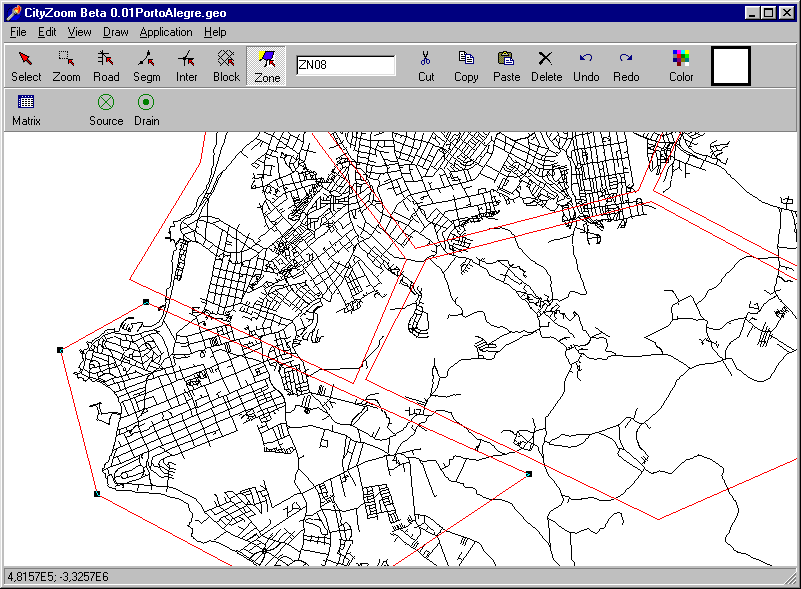 Figure
4 The basic environment interface.
Figure
4 The basic environment interface.
4.
Interfacing with external tools: an example
External tool integration to the environment follows two possible approaches:
1. for application software developed specifically on the CATIA models
and API, inter-tool communication is supported through a plug-in that allows
interaction among objects modeled within CATIA;
2. legacy systems require to be driven or exercised through data file
exchanges in both pre and post-processing phases of the simulation. In
the latter case file formats have to be exported and imported by CATIA,
through one or several tools that are integrated in this tool-oriented
environment. An advantage to the user is that there is no need to deal
directly with the edition of the files that drive the simulator input.
Examples of applications
that are currently integrated to CATIA are SATURN simulator and the CityZoom
(CITYZOOM 1997) set of tools, themselves dedicated
as an environment to model and analyze cities in its urban planning complex
models of land usage, lot occupation, city rules scenarios, among other
models supported by CityZoom.
In the development strategy
of CATIA a decision was made to make it fully integrated to the CityZoom
tool, in a plug-in model of inter-tool communication. Communication among
software objects is the contemporary paradigm used in this project.
The CityZoom environment
aims to aid taking decisions related to the urban planning and design tasks.
The system basic structure relies on the integration of different urban
plant performance models, among them the traffic and transportation models.
Key to the success of this environment is the ability to integrate different
performance models that need to be considered consistently; a change in
land usage criteria has to be dealt with in the traffic modeling and simulations
in a consistent way, for instance. CityZoom has an interactive tool set
to help in dealing with vastly different urban system entities, some of
which are related or are a part of the city traffic network. CityZoom was
implemented following the same modeling and implementation object-oriented
approach and shares with CATIA the same data model to describe the urban
traffic entities.
The first legacy simulation
code supported by CATIA in its current implementation is SATURN, and black-box
wrapping facilities are yet another set of tools developed for the environment.
Supporting external tools of wide commercial acceptance such as, but not
exclusively, SATURN is of paramount importance for successful simulation
environments. Interfaces to third party tools are just another set of tools,
from the CATIA environment standpoint.
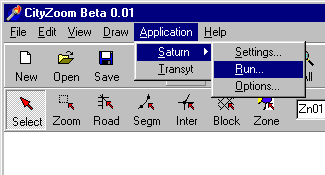 Figure 5
Executing SATURN from the CATIA environment.
Figure 5
Executing SATURN from the CATIA environment.
SATURN aids the analysis
of applying different traffic management schemes. It was implemented in
Fortran and it is a typical file exchanging based tool, since the users
need to edit ASCII files as input parameters to the SATURN functional modules.
SATURN simulations have been done in many cities throughout the world,
e.g. Porto Alegre.
By integrating these tools
into the same software environment, the user can easily benefit from the
CityZoom interactive tools and interface in order to avoid an unfamiliar
SATURN user interface. As another advantage, the user can apply the results
from SATURN running into the common environment as input parameters to
other integrated tools as they use the same urban traffic description model.
The basic environment interface presented to the user is shown in Figure
4 and follows Windows 95 standards like pop-down menu, tool bars, and
a graphic area where traffic entities can be visually selected and edited.
All menus are presented in English for international use.
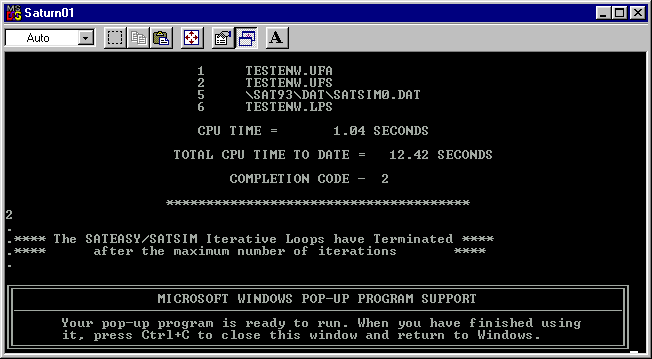 Figure 6 The post-processing
execution of SATURN tool.
Figure 6 The post-processing
execution of SATURN tool.
An example of executing
integrated SATURN functions from the CATIA environment is shown in Figure
5. The edition of input files describing parameters of external tools becomes
user-transparent as the system entities are edited graphically using the
CATIA environment tools. One tool, for instance, is the 2-D network editor.
Once the simulation parameters have been set, the SATURN can run from the
integrated environment, as shown in Figure 5 and Figure
6.
5. Conclusions
The growing complexity of urban traffic models requires the use of
a multitude of advanced software tools for various types of analysis. Although
many of these tools are of wide commercial acceptance they are oriented
to a specific problem. Actually they are efficient in terms of the analysis
results generated but on the other hand they have great limitations related
to their graphical interface. The concepts of the object-oriented approach,
systems integration, and visual interactive simulation make the CATIA environment
a powerful analysis tool for traffic systems studies. Black-box communication
within CATIA facilitates using legacy code, while the plug-in communication
approach makes the implementation of new tools easier and increases its
applicability as a growing number of tools are integrated to the environment.
This offers the engineers an appropriate way to test different policies
of urban traffic management and control, as well as a greater integration
to the city planning tools such as those incorporated into the CityZoom
environment.
References
Akçelik, R. (1991) SIDRA 4.0 software status. Traffic
Engineering and Control, 32(12); 585-589.
Barcelo, J. (1991) Software environment for integrated RTI simulation
systems. In: Advanced Telematics in Road Transport, Proceedings of the
DRIVE Conference, (Brussels, Feb. 4-6). Elsevier, Amsterdam, vol.2, 1095-1115.
Briceño, C., Taladriz, U., and Valenzuela, E. (1995) Interfaz
gráfica para modelación de redes de transporte. In: Actas
del Séptimo Congreso Chileno de Ingeniería de Transporte
(Santiago, Oct.). [s.n.], Santiago, 534-546.
CITYZOOM (1997) CityZoom: a software environment to support taking
decision on urban and architecture design (in Portuguese). URL: http://www.inf.ufrgs.br/cei/CityZoom/CityZoom.html.
Paksarsawan, S., Montgomery, F. O., and Clark, S. O. (1992) How
TRAF-NETSIM works. Working Paper 380. Institute for Transport Studies,
University of Leeds, Leeds, UK.
Rossetti, R. J. F. (1998) A software environment to support
urban traffic system simulation. Master's Thesis (in Portuguese). Computer
Science Post-Graduate Program, Universidade Federal do Rio Grande do Sul,
Brazil.
Rumbaugh, J., Blaha, M., Premerlani, W. and others (1991) Object-Oriented
modeling and design, Englewood Cliffs, NJ.: Prentice-Hall.
Taylor, N. B. (1990) CONTRAM 5: an enhanced traffic assignment
model. TRRL Research Report 241. Transport and Road Research Laboratory,
Department of the Environment, Crowthorne, Berkshire, UK.
Van Vliet, D. (1992) "SATURN - Simulation and assignment of traffic
in urban networks: SATURN 8.4 - A users' manual." Saturn Documentation.
Institute for Transport Studies, University of Leeds, Leeds, UK.
Watling, D. (1991) "A review of models of urban traffic networks
(with particular reference to the requirements for modelling dynamic route
guidance systems)." Working Paper 356. Institute for Transport Studies,
University of Leeds, Leeds, UK.
Willumsen, L. G. and Coeymans, J. E. (1989a) The value of fixed-time
signal co-ordination in developing countries: I - Application of TRANSYT
in Santiago." Traffic Engineering and Control, London, 30(2);
58-62.
Willumsen, L. G. and Coeymans, J. E. (1989b) The value of fixed-time
signal co-ordination in developing countries: II - Improved bus modelling
and results. Traffic Engineering and Control, London, 30(2);
126-134.
Willumsen, L. G. and Coeymans, J. E. (1989c) The value of fixed-time
signal co-ordination in developing countries: III - Evaluation of benefits.
Traffic Engineering and Control, 30(4); 185-188.
ACKNOWLEDGEMENTS
This project
has been supported by the FAPERGS Foundation. The authors gratefully acknowledge
the contribution and interaction with the CityZoom software development
team and the valuable suggestions and comments provided by the LASTRAN/UFRGS
Laboratory, in particular by Helena Cybis.
 JGIDA
vol. 3, no. 1
JGIDA
vol. 3, no. 1
JGIDA
Home

 JGIDA
vol. 3, no. 1
JGIDA
vol. 3, no. 1