How do we exercise
fish?
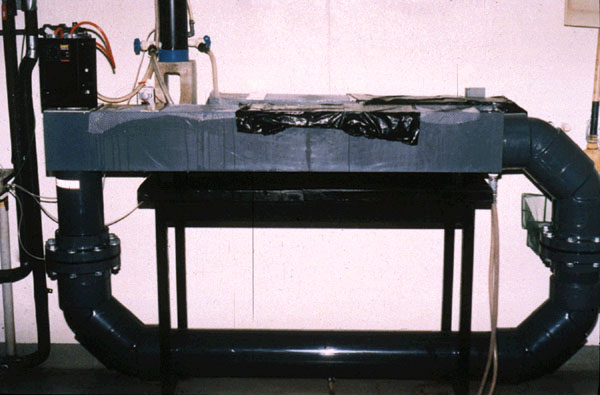 There are a couple of ways to make
a fish exercise to exhaustion. One is to use a swim tunnel, in
which a current is generated by an impeller. Trout will naturally
swim against the current. The current velocity can be increased
until the fish exhaust and is no longer able to maintain its position
in the swim tunnel. This method works well for small (<20 g)
fish, but you need a really BIG tunnel to exhaust bigger fish.
There are a couple of ways to make
a fish exercise to exhaustion. One is to use a swim tunnel, in
which a current is generated by an impeller. Trout will naturally
swim against the current. The current velocity can be increased
until the fish exhaust and is no longer able to maintain its position
in the swim tunnel. This method works well for small (<20 g)
fish, but you need a really BIG tunnel to exhaust bigger fish.
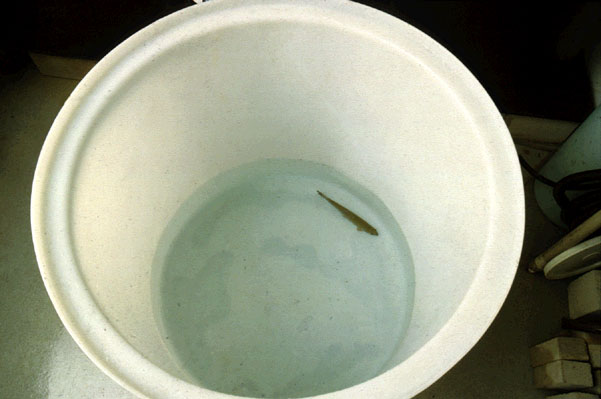
A second method, somewhat cruder but
just as effective, is to place fish in a circular swim tank and
manually chase them around the tank for about 5 min.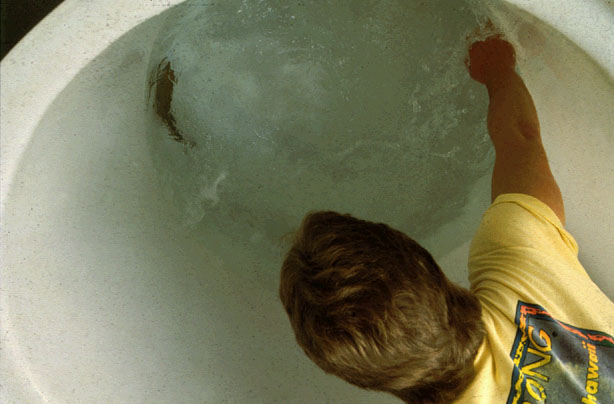
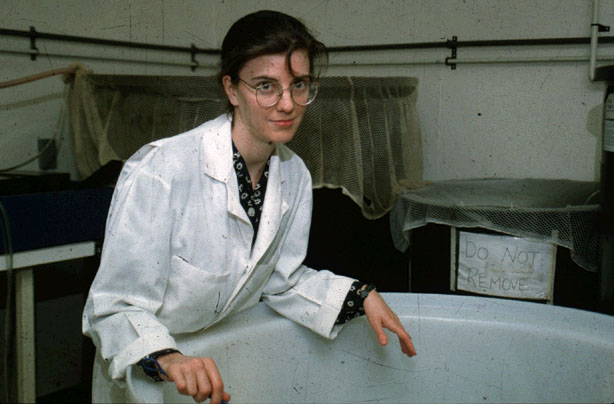
At this point, the fish is exhausted
(not to mention the hard-working student!) . This has become a
very common method used to exercise fish to exhaustion.
How do we study fish
physiology?
Well, that depends upon the
question asked. Typically, we want to assess physiological changes
within the fish. The simplest way to do this is to sample blood
and measure parameters of interest (e.g. levels of hormones, and/or
metabolites). A common and useful method for obtaining blood samples
from fish is to surgically implant a catheter 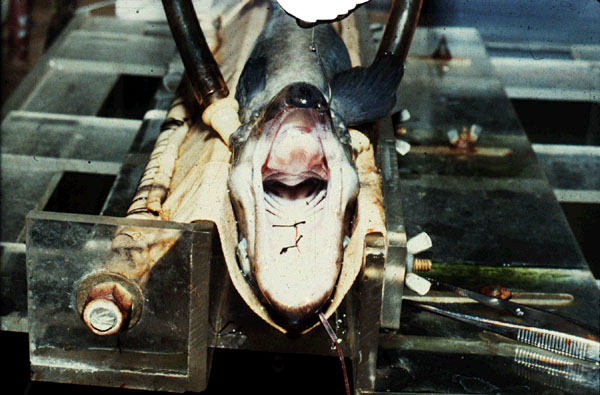 in
a blood vessel while the fish is anaesthetized. This technique
is quick (~15 min), the fish survives and it allows us to obtain
several blood samples from a individual fish with minimal disturbance
to the fish. After surgery, the fish are placed in individual
boxes and allowed to recover. We can then exercise them and measure
several parameters in the blood.
in
a blood vessel while the fish is anaesthetized. This technique
is quick (~15 min), the fish survives and it allows us to obtain
several blood samples from a individual fish with minimal disturbance
to the fish. After surgery, the fish are placed in individual
boxes and allowed to recover. We can then exercise them and measure
several parameters in the blood.
What
aspects of fish physiology & biochemistry are we studying?