
About Pattern Images...
Standard digital images are by now omnipresent. Composed of the all-too-familiar pixels, digital images are essentially a simple 2-tiered construct. The Pattern Images shown here have a cell/icon/image 3-tier hierarchy. The enriched structure augments the limited representational power of the (atomistic) pixel with the more diverse graphic representation of the aggregate (molecule).
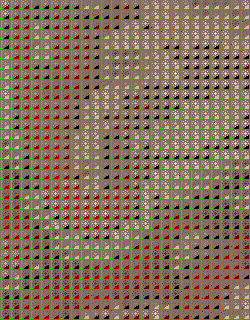 |
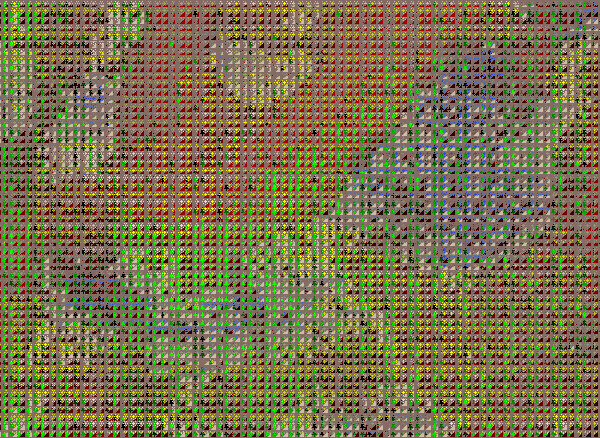
Pattern Images allow the user to map the interrelation of several variables, on a single image, for many (e.g. millions of) locations - at each and every location.
Pattern Images can have substantial information content and aesthetic appeal. Furthermore, a Pattern Image can be overlayed with conventional point, line, area, or surface images.
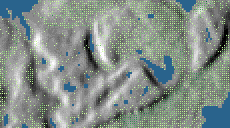 |
Our examples are geographic -maps and images of terrain, satellite and thematic data. Note however, that sub-cell pattern images can be applied to photographs and other pixel-based graphs, such as data graphs.
The sub-cell aggregate model used approaches the classic (carto)graphic map overlay problem in a non-standard and unique way. By changing cell resolution, multi-cell constructs are produced which are then manipulated to achieve a micro-spatial-neighborhood based overlay.
Aggregate constructs have information representation advantages over the single-cell image processing paradigm. Current image processing programs have brought single cell image processing to the desktop. The case is made for the support of multi-cell pattern creation and processing capabilities in future generations of image processing software.
 |
Last modified by Daniel Fox January 18, 2001