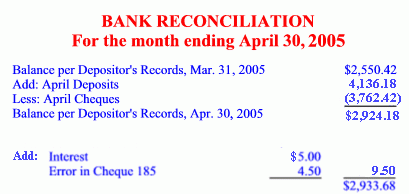
Additions to Our Records
Your next concern is finding out what entries occurred during the month in your bank account that you do not know about. Start by verifying that each item on the bank statement (Exhibit 1) appears in your records (the cash disbursements list, the cash receipts list and the previous reconciliation). Highlight the items on the bank statement that are not listed in your cash receipts (Exhibit 3) or cash disbursements (Exhibit 2). Items that increase the bank's balance should be added to your cash balance. Items that decrease the bank's balance should be subtracted from your cash balance.
A reminder...
We need to look at the previous bank reconciliation statement as part of our records too, as we are likely to have late deposits that will be added to the bank's records early in the month. We had one deposit in transit at the end of March. It was recorded by the bank on April 1; therefore, we do not have to make an adjustment for it.
As you look through the bank statement, there are three items on the bank statement that we have not recorded in our cash receipts or on a previous reconciliation. This item increases the bank statement balance.
Item #1 - Interest Earned
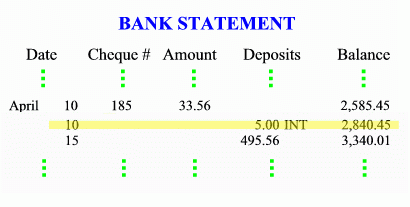
The first item is the $5 interest earned on the account. It can be seen on the bank statement (Exhibit 1). This item increased our bank balance, so we should add it to the bank balance in our records.
Item #2 - Error in Cheque 185
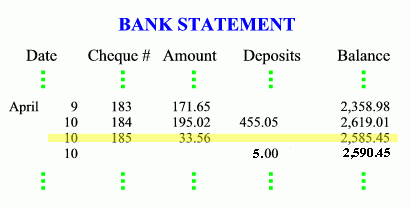
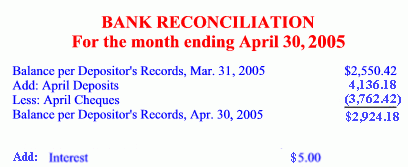
There is one other item that requires us to make an addition to our records. Cheque #185, highlighted in yellow above, was incorrectly recorded in our records (The case instructs you to assume any errors were made by MMM.) as $38.06. Cheque #185 was cashed by the bank for $33.56. We have overstated that disbursement by $4.50 in our records. To reverse the error, we should add $4.50 to our records on the bank reconciliation statement.