Home
People
Research
Publications
Vacancies
Links
Contact Us
Biology Home |
We
are
interested in all manner of things associated with
arthropods at low temperatures (and sometimes at high
temperatures, too!). Below you can read about some
of the things happening in the lab. Watch this space and
the publications page to see how
things develop.
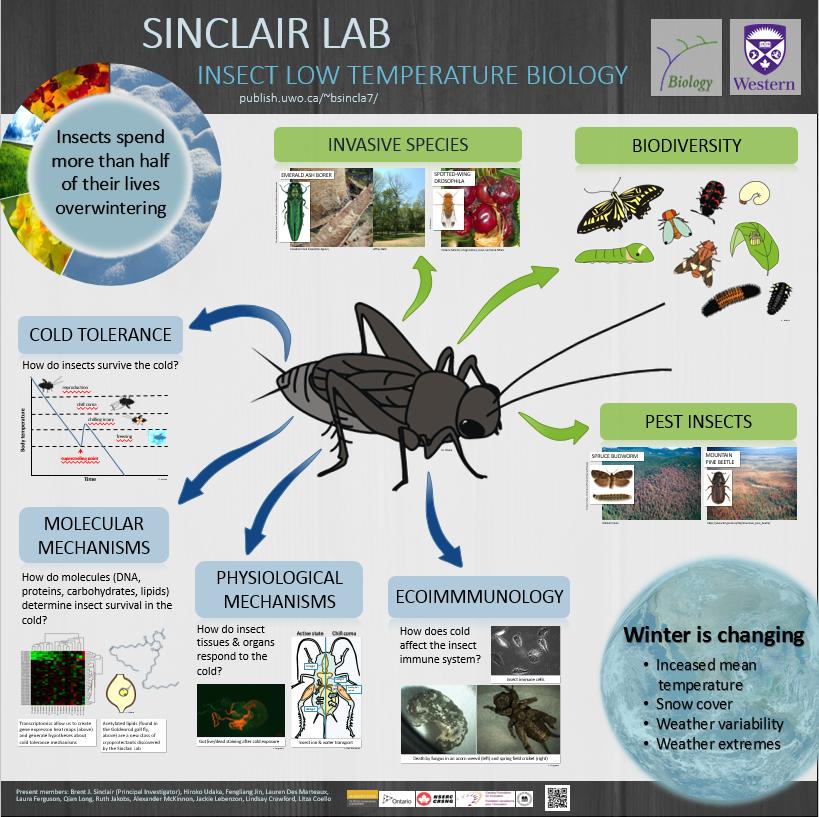
My interests are broad, and as a result we have
a lot of different projects going on in the lab. Almost all
of it is around the theme of insect low temperature biology (of
course), but we do make occasional forays elsewhere. Some current
projects (in no particular order):
- Mechanisms underlying insect freeze tolerance
- That's why I started studying insects in the first place, and
we have developed the cricket Gryllus veletis as a
model species for studying insect freeze tolerance.
Transcriptome, metabolome, genome, fitness, neuroscience,
mitochondrial biology - we're trying to do it all! This is a
priority area of recruitment in the Sinclair lab right now.
- Evolution of thermal biology - Together with
Thomas Buckley and Kate Augustine of Landcare Research, we
are using the well-documented radiation of New Zealand stick
insects to understand how thermal performance curves evolve.
- Overwintering biology of Colorado Potato Beetle
- this species is an important economic pest... but for us it's
just a great model for exploring everything from molecular
physiology of metabolic suppression to the role of the gut
microbiome in overwintering success. Lots of opportunities for
new people to work on this topic.
- Multiple stressors during overwintering -
Winter brings with it lots of stressors besides cold - we are
exploring the interactions between cold, immune and chemical
stress in the hopes of figuring out how to predict the impact of
interacting stress.
- Temperature effects on the microbiome - We
are not alone! All animals carry with them a huge
community of symbionts and potential pathogens. It'd be
great to understand how these little creatures interact with
their hosts to modify responses to the environment.
- Cold tolerance of northern arthropods -
There are many arthropods in the Arctic, and we know almost
nothing about how they survive up there. We've done a little bit
of work on arachnids in the Yukon and and Greenland, and we are
just beginning work at CHARS in Cambridge Bay, Nunavut.
- New tools for studying insect cold tolerance
- Exciting things are afoot when it comes to conducting
manipulative experiments to understanding the mechanisms
underlying insect cold tolerance. We're working on RNA-Seq,
RNAi, CRISPR/Cas9 and all sorts of other goodies!
- Overwintering energetics - We've been working
on energetics and metabolism of overwintering insects (and
frogs, once), and are continuing to do this, mainly with pest
insects at the moment.
- Invasive species biology - One of the first
questions people ask when a new pest comes to Canada is 'it's
kind of cold here... will it survive the winter?' Well - we're
the people to ask if you want to find out! We work on many of
the biggest and baddest insect pests in the world right now,
including spotted-wing Drosophila, Asian Long-horn Beetle,
Emerald Ash Borer, and Brown Marmorated Stink Bug. Our Asian
Long-horn Beetle work is part of the Genome Canada-funded
BioSAFE project. We are also collaborating with Tara Gariepy at AAFC to use thermal
biology to improve the success of biocontrol agent releases.
|
 |